
Is Custom Wood Engraving Worth It? A Buyer's Guide
Last Updated: November 5, 2026
Quick Summary
Custom wood engraving is worth it when the piece is meant to be kept, displayed, and tied to a specific person or occasion, such as a wedding, new home, or retirement. Skip it for bulk promotional items at the lowest unit cost or when the recipient won't recognize the personalization as personal.
- Laser engraving is flat to the touch and burns brown to black rather than adding color.
- Our Custom Logo or Artwork Cutting Board starts at $24.99 with the reverse side for cutting.
- Choose a custom service for one piece or a small batch that needs design redraw.
- Maple, cherry, and bamboo produce the highest-contrast, crispest engraving results.
- Use the engraved face for serving or display and the reverse side for cutting.
Table of Contents
- The Verdict: When Custom Wood Engraving Is Worth It
- Laser Engraving Wood Pros and Cons
- What Wood Engraving Cost Actually Looks Like
- The Best Wood for Laser Engraving
- How Custom Wood Engraving Compares to Carving and Inlay
- Durability, Finish, and Real-World Maintenance
- Wood Laser Engraving Ideas by Project Type
- Choosing Your Engraved Keepsake from Copper Fox Co
- Frequently Asked Questions
The Verdict: When Custom Wood Engraving Is Worth It
Custom wood engraving is worth it when the piece is meant to be kept, displayed, and tied to a specific person or occasion. It stops being worth it when you need something disposable, uniform, or delivered overnight.
A laser engraving costs more than a printed or stamped alternative, and the premium only pays off when the personalization carries meaning the recipient will hold onto.
The Short Answer
Custom wood engraving is a personalization method where a laser burns a design into the wood surface rather than printing on top of it.
Buy it when the gift marks a milestone: a wedding, a new home, a retirement, a recipe from a grandparent. Skip it for bulk promotional items at the lowest unit cost, or when the recipient won't recognize the personalization as personal.
The line is meaning, not price.
Laser Engraving Wood Pros and Cons
Laser engraving wood is precise, permanent, and repeatable, but it darkens the surface rather than adding color, and it cannot produce the raised texture of hand carving. Whether those trade-offs matter depends entirely on what you are making.
Where Laser Engraving Wins
Precision is the headline. A laser follows a digital file closely, so fine text, small logos, and detailed line art can be reproduced consistently across a batch.
Repeatability matters too. Once the design file is set, each board can be produced to the same design, which suits client gifts and business branding runs where every piece must match.
The laser engraves into the top layer of wood rather than sitting on top of it the way ink or vinyl does.
Where It Falls Short
Contrast is the limitation buyers notice first. A laser burn is brown to black, so it can read less clearly on darker woods unless the design is large and simple.
Texture is the second gap. Laser engraving is flat to the touch. If you want a raised or recessed design with physical depth, that is carving or inlay work, not laser work.
Watch out: dark wood plus small, delicate lettering is the most common disappointment in this category. The design is technically perfect and visually invisible.
What Wood Engraving Cost Actually Looks Like
Wood engraving cost is generally driven by setup, material, and quantity. A batch can spread setup across more units, which is why per-unit cost often falls with volume.
The Four Cost Buckets
Custom wood engraving quotes are generally built from a few common cost components:
One-Off versus Batch Production
Our Custom Logo or Artwork Cutting Board starts at $24.99. You supply the logo or artwork, we engrave it, and the reverse side is for cutting.
Service versus DIY: When Each Pays Off
DIY only beats a custom service when you already own the machine or plan to engrave regularly. The equipment, ventilation, and software learning curve are real costs that a single gift rarely recovers.
- Choose a custom service when you need one piece, a small batch, or a design that must be redrawn from a photo or handwriting sample. You pay for the file work, the test burn, and the finish, and you get a consistent result without buying equipment.
- Choose DIY when you already own a laser or CNC machine, have a ventilated workspace, and plan to engrave many pieces over time. The per-unit cost then drops toward material and machine time, but only after the equipment is paid for.
- Choose a local maker or small shop when you want a mid-volume run with a human checking spelling and layout before the burn. That review step is where most batch errors are caught.
Watch out: a quote that is dramatically cheaper than others often excludes design redraw or finishing, so confirm what is included before comparing totals.
Turnaround and Repeatability
Turnaround depends on whether the design file already exists. A clean, print-ready file moves into production quickly; a photo or handwriting sample that needs redrawing adds a proofing step. For batches, the repeatability of a digital file is why every unit matches, which hand work cannot guarantee. Ask for a proof or test burn on the actual wood species before a large run, because contrast changes with the material.
The Best Wood for Laser Engraving
The best wood for laser engraving is a tight-grained hardwood with a light to medium tone: maple, cherry, and bamboo consistently produce the highest-contrast, crispest results. Dark, open-grained, or resinous woods fight the laser and produce muddy or uneven burns.
Hardwood versus Softwood
Hardwoods generally engrave more cleanly because their denser grain holds a sharp edge.
Wood species also change the final look:
Custom Logo or Artwork Cutting Board →
- Bamboo: light, distinct grain, strong contrast, budget-friendly
- Cherry: warm reddish-brown, classic, develops character over time
- Walnut: rich and dark, beautiful but low contrast for fine text
- Mahogany: deep warm color, best with bold, simple designs
Surface finish matters as much as species. Our boards are conditioned with food-safe mineral oil.
How Custom Wood Engraving Compares to Carving and Inlay
Custom wood engraving removes or darkens the surface, traditional carving cuts physical channels into the wood, and wood inlay sets contrasting material into a recessed cavity. Each produces a different look, a different level of depth, and a different price point.
Laser Engraving versus Traditional Carving
Traditional carving cuts physical channels into the wood, producing tactile depth that laser engraving does not. Flat engraving keeps the surface smooth, which is generally preferable for a board that is used for food preparation.
Laser Engraving versus Wood Inlay
Hardwood inlay is the most visually striking option: a dark walnut shape set into a maple field, or a light maple monogram set into walnut. Inlay sets a contrasting wood into a recessed cavity, which can create strong visual contrast.
Durability, Finish, and Real-World Maintenance
Moisture and neglect are the main factors that limit how long an engraved board stays in good condition. The useful distinction for a buyer is between surface appearance, which can change with use and still be fine, and structural damage, which is what actually ends a board's life.
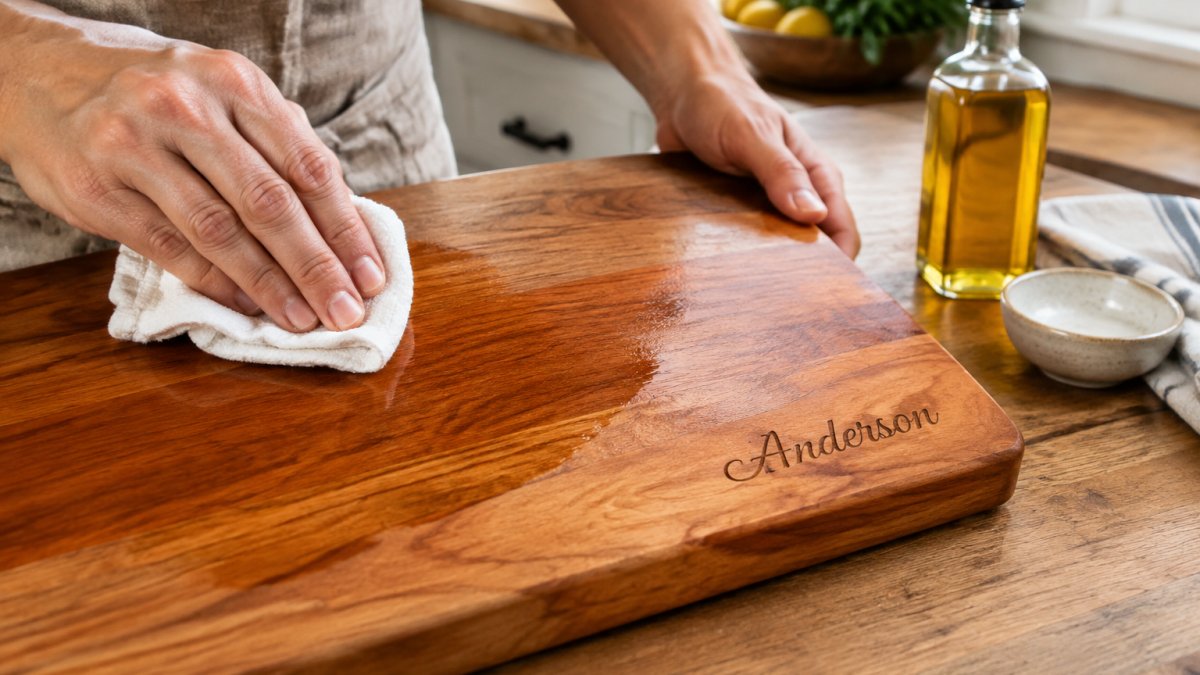
Hands applying food-safe mineral oil to a cherry wood cutting board with a cursive engraved family name
What Each Threat Actually Does
- Sunlight. Ultraviolet light fades and shifts the color of unfinished or lightly oiled wood over time, and can lighten the contrast of an engraving on a sunny windowsill. The burn mark itself does not peel or flake, but the surrounding wood can change tone, softening the visual contrast. Keeping a display board out of direct sun preserves the look.
- Moisture. Water is the real enemy. Soaking, standing water, and dishwasher cycles swell and crack the wood, and repeated wet-dry cycles open glue lines and warp the board. The engraving survives moisture; the wood around it does not.
- Abrasion. Knife marks, scrubbing pads, and stacked dishes wear the surface. On the engraved face, heavy abrasion can dull the crispness of the burn over years, a surface change, not structural failure, and why the plain side is for cutting.
- Refinishing. Light sanding and re-oiling can refresh a worn surface, but sanding too aggressively on the engraved face can thin the burn and reduce contrast. Refinish the plain side freely; treat the engraved side gently.
Surface Appearance versus Structural Damage
Use the engraved face for serving or display, and the reverse side for cutting, which helps preserve the design. For a full routine, our guide on how to care for wooden cutting boards walks through oiling schedules and stain removal step by step.
How Long It Actually Lasts
On the heirloom question: a board that is oiled, hand-washed, and stored dry will outlast most of the kitchens it lives in. The engraving itself does not wear off with normal use. The wood fails when it is left wet, not when it is used.
Watch out: the most common cause of early failure is the dishwasher, not the engraving, so confirm care instructions with anyone who will actually use the piece.
Wood Laser Engraving Ideas by Project Type
Wood laser engraving ideas work best when the design matches the object and the occasion.
Here is how we would match projects to formats:
Project |
Best Format |
Why It Works |
|---|---|---|
Wedding gift |
Cursive name and date |
Reads as a keepsake, not a kitchen tool |
Housewarming |
Family name, established date |
Fits the new home, stays on display |
Family keepsake |
Handwritten recipe |
Personal in a way a font cannot copy |
Business or client gift |
Logo or custom artwork |
Consistent across a batch |
Teacher or mentor gift |
Short message or name |
Small, personal, easy to display |
For a family piece, a handwritten recipe cutting board turns a relative's handwriting into a kitchen keepsake. For corporate orders, a custom logo or artwork cutting board can be used for the same idea.


A common mistake is over-designing. One name, one date, one clean layout beats five lines of text crammed onto a small board every time.
Choosing Your Engraved Keepsake from Copper Fox Co
Choosing an engraved keepsake comes down to three decisions: the design, the wood, and the size. Get those right and the piece fits the recipient's home instead of sitting in a drawer.
Our boards are custom engraved in Utah, finished with food-safe mineral oil, and built with a display side and a cutting side.
Start with the custom cursive text cutting board if you want a name, date, or short phrase, then choose wood and size from the available combinations.

Custom Cursive Text Cutting Board
Watch out: ordering a dark wood with small script is the mistake we see most. Choose a lighter wood for fine lettering, or a bolder layout for walnut and mahogany.
The real test of a personalized gift is whether the recipient keeps it after the occasion passes. If you are still weighing whether personalization is worth the spend, read why personalized gifts beat generic ones before you order.
Frequently Asked Questions
Is custom wood engraving worth the extra cost?
It depends on what you are buying. For a gift that will sit on a shelf, a printed personalization does the job. For something used and displayed for years, custom wood engraving earns its price. Copper Fox Co boards start at $24.99, and the engraving is cut into the wood rather than printed on top, so it does not peel or fade with handling. The value comes from the piece being useful, personal, and unlikely to be replaced.
How much does wood engraving cost?
Wood engraving cost tracks the size of the piece, the wood species, and whether the design is one-off or repeated. At Copper Fox Co, a custom logo or artwork cutting board starts at $24.99, a cursive text board starts at $24.99, and a handwritten recipe board starts at $45.99. Gift sets that add oil, crackers, or charcuterie accessories cost more than the board alone.
Does laser engraving last on wood?
Yes, when the engraved face is treated as the display side. Copper Fox Co finishes boards with food-safe mineral oil and recommends cutting on the reverse side to preserve the design. Hand wash with mild soap, dry promptly, never soak or use a dishwasher, and re-oil periodically.
What is the best wood for laser engraving?
Hardwoods hold fine detail best because their tighter grain keeps lines crisp. Cherry and walnut have warm, rich tones, mahogany gives deep, warm coloring, and bamboo is a lighter option with distinctive grain. Copper Fox Co offers bamboo, cherry, walnut, and mahogany depending on the board style and size you choose.
Can engraved wood gifts be used as cutting boards?
Yes. Copper Fox Co engraves the display face and leaves the reverse side for cutting to help preserve the design. Our boards are conditioned with food-safe mineral oil.
